
Skip to content
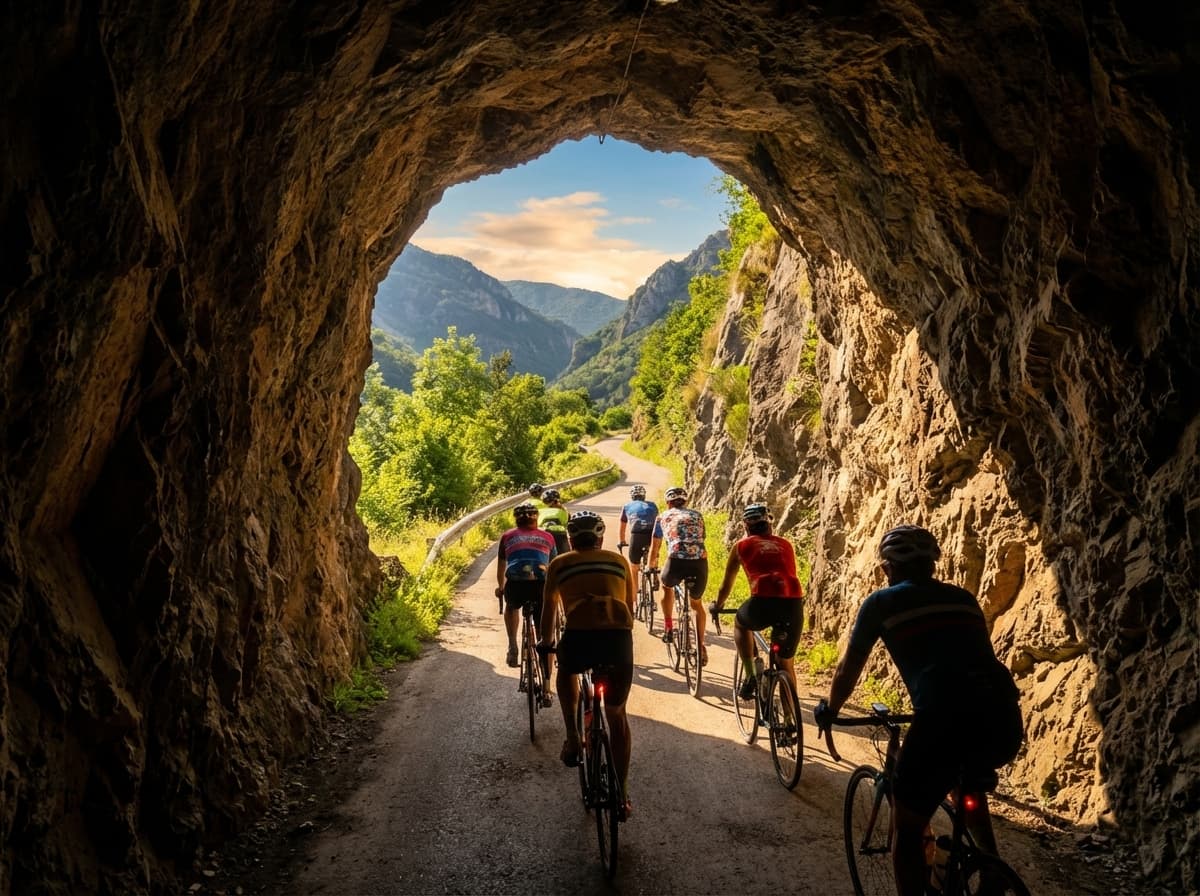
Tunnel of the old mining railway on the Bear Trail

Legacy of the mining railway

The Bear Trail tunnels the mining railway legacy

More than 30 tunnels carved into the rock during the 19th century for the mining railway that linked Teverga and Quirós to Trubia. Today, all refurbished and lit with solar power.

How many tunnels there are
+30 Tunnels
300 m Longest
1882 Built
Solar LED Lighting
Discover more

How many tunnels

More than 32 tunnels along the full Y

More than 30 tunnels carved into the limestone along the full Y route. The exact number varies by source: the Bear Trail Greenway Natural Path (official name in the Spanish Greenways network) documents 32 tunnels with lighting.

Most are short tunnels (20–80 m) the mining train needed to dodge limestone outcrops. Several are 100–150 metres, and one reaches 300 metres — the longest and most dramatic.

~15 tunnels

Trunk Tuñón → Caranga

~12 tunnels

Teverga branch (+ longest)

~5 tunnels

Quirós branch

20–300 m

Length range

Tunnels of the old mining railway on the Bear Trail Mining railway · since 1882

Why so many

History of the mining railway

The Bear Trail sits on the old route of the Trubia mining railway, built between 1882 and 1904 by the Asturian Industrial Society Santa Bárbara to haul coal from the Teverga and Quirós mining basins down to the Trubia steelworks on the river Nalón.

The route followed the lie of the land — the Trubia and Teverga valleys are narrow and hemmed in by limestone walls — and to keep the minimum gradient a freight train can cope with (1-2%), engineers had to bore through the rock at every sharp bend of the river.

  1. 1882–1904 Construction of the Trubia mining railway
  2. 1963 Closure after the Asturian coal crisis
  3. 1995 Converted into a Greenway by the Principality
The longest

300 metres of lit darkness

300 m
  • Location Teverga branch
  • Section Caranga → Entrago (downhill)
  • Lighting Overhead solar LED + river openings

The longest tunnel on the Bear Trail is on the Teverga branch, on the Caranga → Entrago section (downhill). It measures 300 metres and cuts through a limestone outcrop that separates two bends of the river Teverga.

It has side openings towards the river — windows carved into the rock that let in daylight and let you lean out to see the water below. It was a common 19th-century railway technique, allowing steam engine smoke to ventilate.

On cloudy days the lighting can be dim — always carry your own torch, especially with children.

Tunnels by section

Where the tunnels are

Tunnels are not evenly distributed across the 3 sections: the trunk and the Teverga branch concentrate most of them.

Trunk

Tuñón → Caranga

~15 tunnels

The highest concentration. Between Proaza and Buyera you go through several consecutive tunnels in just minutes. They are the most photographed as they're near the Molina enclosure and Peñas Juntas.

Teverga branch

Caranga → Entrago

~12 tunnels

Crosses the Valdecerezales gorge with several tunnels between dramatic limestone walls. The longest tunnel (300 m) is here.

Quirós branch

Caranga → Santa Marina

~5 tunnels

Fewer tunnels, more open. The branch with the least railway feel, with more pastoral scenery.

Want to compare the 3 sections in detail? Where to start the trail

Sunlight inside the rock

Solar LED lighting

All main tunnels are fitted with solar-powered LED lighting installed on the surface above the rock. The system is triggered by presence sensors (not always on) and runs fully off-grid — there is no mains power inside the tunnels.

When it can fail

  • In winter with few consecutive sunny days, some tunnels may have weak lighting
  • After storms or with snow on the solar panels
  • A sensor may take 2-3 seconds to activate as you enter

That's why we always recommend carrying your own torch or headlamp — just in case, for peace of mind.

Tunnel lit with solar-powered LED lighting

Practical tips

When you go through the tunnels

Short recommendations to enjoy them safely and get the best photos. Solar LED lighting, compacted surface and more than 30 tunnels along the Y.

Safety

Before entering

  • Your own torch or headlamp

    Even if the lighting works, having one is more comfortable.

  • Bike with active lights

    Front and rear, even in daylight.

  • Mind the descents

    Descending cyclists go fast. Keep to the right.

  • Put your phone away

    The surface is uneven and it's easy to trip.

Etiquette

With others

  • Silence or moderate volume

    The echo inside the tunnels is strong.

  • With children

    Walk alongside and hold hands with small kids.

  • With dogs

    Some get scared. Keep them on a lead and talk to calm them.

Experience

For the photo

  • Photography

    The best shots are at the tunnel exit, looking for the light/shadow contrast.

  • No strong flash

    Out of respect for other visitors inside the tunnel.

  • Best time

    Midday with overhead light through the side openings.

FAQ

Questions about the tunnels

What people ask about the 30+ tunnels of the old railway that cross the Bear Trail.

Lit tunnel of the Bear Trail

Need help?

+34 644 199 430
1.

How many tunnels does the Bear Trail have?

More than 30. The Bear Trail Greenway Natural Path documents 32 lit tunnels distributed along the 3 Y sections. The highest concentration is on the Tuñón-Caranga main trunk and on the Teverga branch.

2.

Which is the longest tunnel?

The longest tunnel measures 300 metres and is on the Teverga branch (Caranga → Entrago section). It has side openings towards the river Teverga and overhead solar lighting.

3.

Are the tunnels lit?

Yes. All main tunnels have solar-powered LED lighting that activates on presence sensors. On very cloudy days or after snow a few may fail — we always recommend bringing your own torch or headlamp.

4.

Are the tunnels safe?

Yes. They're in perfect condition, refurbished in 1995 and under regular maintenance. The only real caution is cyclists coasting downhill — keep to the right and use active front and rear lights.

5.

Why are there so many tunnels?

Because the trail runs on the old 19th-century mining railway that brought coal from Teverga and Quirós down to Trubia. The valleys are narrow and enclosed, and to keep the minimum gradient a train can handle, engineers had to bore through the rock at every sharp bend.

6.

Are they good for photography?

Very much so. The best shots are at the exit of each tunnel, using the contrast between inner darkness and outdoor daylight. Tunnels of 100+ metres also allow dark-tunnel portrait effects. We recommend no strong flash out of respect for other visitors.

Ready for the photo

Take your time to enjoy the tunnels

If you come by bike, we give you a map with tunnels marked and tell you which have the best angles before you set off. We've been riding the route for years and know where the good shots are.

← Back to the Bear Trail pillar